Interested in Korea? This Korean Dish Is Dangerous… We Ate It for 3 Days Straight
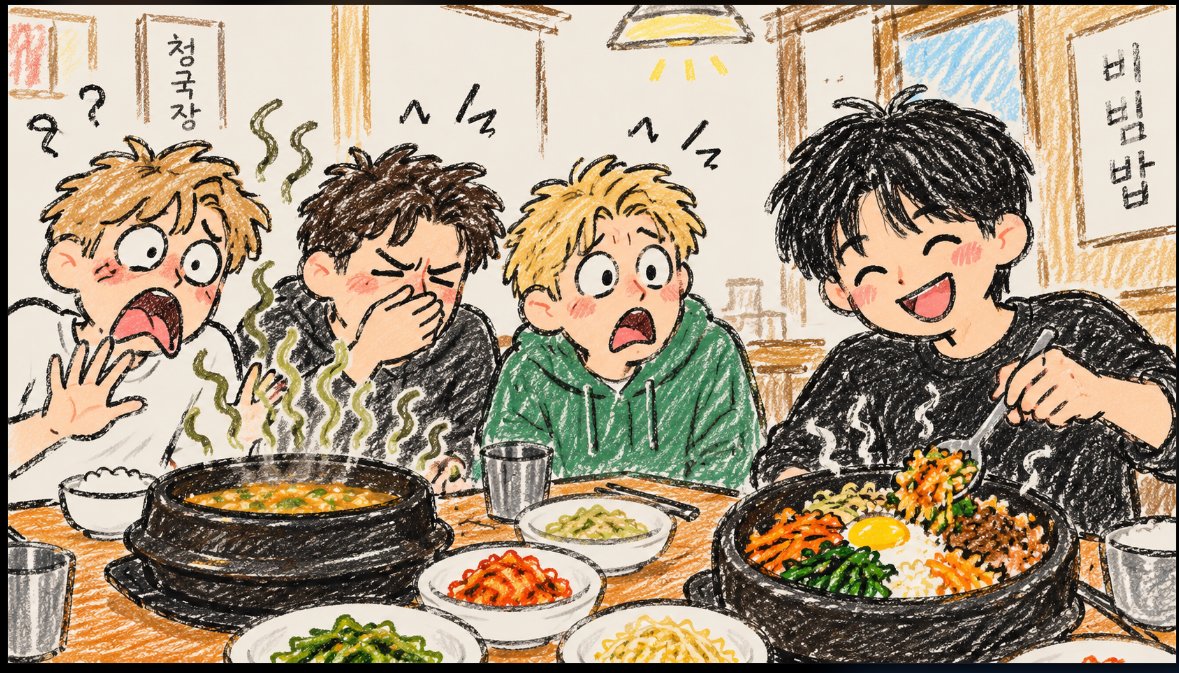
Three foreign friends came to visit me in Korea. One of them knew exactly what he wanted to eat.
Bibimbap.
More specifically, dolsot bibimbap, served in a hot stone bowl.
He had tried it at a Korean restaurant back home and loved it. Now that he was finally in Korea, he insisted on having it again.
I was happy to take him. I love dolsot bibimbap, too. The rice gets slightly crispy at the bottom of the hot bowl, and that's my favorite part.
I wanted my friends to experience real Korean food, so I ordered a bowl of cheonggukjang, a pungent fermented soybean stew, to eat with our bibimbap.
As soon as it arrived, I noticed their expressions. The smell was clearly unfamiliar to them.
I told them to give it a try.
"It might smell a little strange at first, but you might end up liking it. If you're not sure what to do with it, just eat it the way I do."
Then I took a spoonful of cheonggukjang and mixed it into my bibimbap.
My friends looked at me as if I'd completely lost my mind. They had just been struggling with the smell, and now I was mixing it right into my rice.
Personally, I thought the cheonggukjang made the bibimbap taste even nuttier.
Just a moment ago, these guys had been staring at me in disbelief. Now they were adding cheonggukjang to their own bowls and mixing it in, too.
While we ate, I told them that there are many kinds of bibimbap, including yukhoe bibimbap, made with raw beef, and Jeonju bibimbap, a famous regional variation.
They seemed interested in trying more of them.
The next day, we were supposed to have samgyeopsal, or Korean grilled pork belly.
But my friends weren't interested.
They wanted bibimbap again.
Seriously? They'd come all the way to Korea and were turning down Korean barbecue for bibimbap?
In the end, we ate bibimbap for three days.