My Friend Was Already Imagining Worst-Case Scenarios Before He Even Walked Through My Front Door
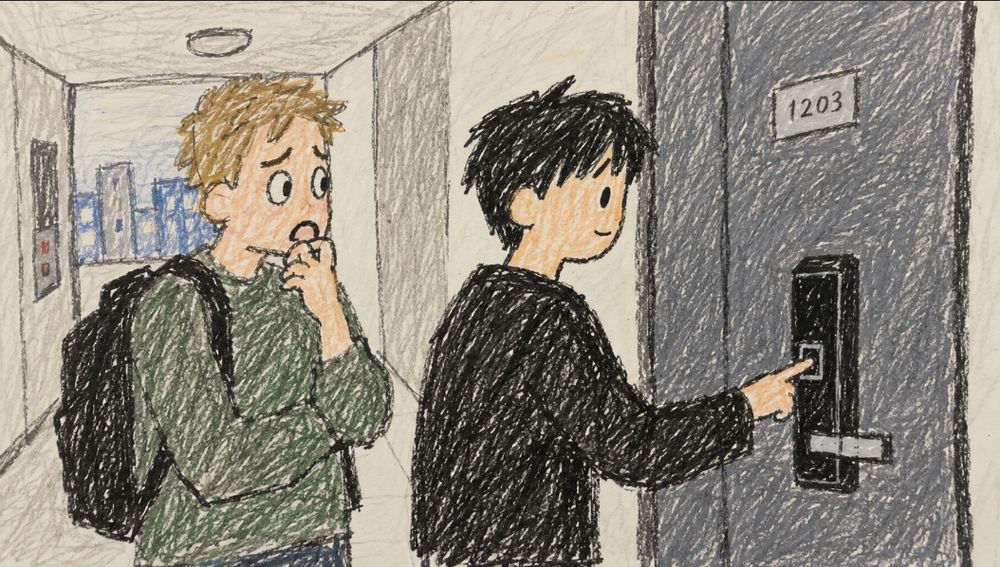
There are a lot of apartments in Korea. Sure, there are standalone houses too, but apartments, low-rise residential buildings, officetels — that kind of housing is way more common. I live in an apartment myself.
A few years back, my friend Timmy came to visit Korea for the first time and stayed with me for a while. But even before he stepped inside my place, there was already something he found weird.
My front door lock.
My apartment doesn't use a key. It's a fingerprint lock. I just did what I always do — touched my finger to the sensor and opened the door — but Timmy wasn't exactly amazed. He looked kind of worried, actually.
"Wait, is this okay though?"
"What do you mean?"
"What happens if the battery dies? You don't even have a key. Doesn't that mean you're locked out of your own house?"
That actually made me stop and think for a second. Huh. What does happen if the battery completely dies?
Honestly, I'd never once thought about this in my entire life of using door locks in Korea. Usually the lock beeps a low-battery warning way before it actually dies, so I've genuinely never been locked out because of a dead battery.
Still, his question got me curious, so I looked it up. Turns out plenty of these locks have a backup power feature — there's an external terminal on the outside of the lock where you can connect a portable battery and get just enough juice to open it. It varies by model, so you'd want to check your specific lock's manual, but at least a dead battery doesn't automatically mean you're stuck outside your own home.
When I explained this to Timmy, he nodded slowly.
"Huh. Okay, that actually is pretty convenient then."
But that got me wondering something else. Wait — is this kind of digital lock actually not that common outside Korea?
Turns out it's not as universal as I thought
I've lived in Korea my whole life, so I've never thought of digital door locks as anything special. Punch in a code, or touch a fingerprint sensor. To me, that's just... one of the normal ways you open a front door.
But looking into it, there's actually a real gap here. Smart locks do exist in the US — fingerprint, code, phone-based, all of it. But it's nowhere near as standard in everyday apartment life as it is in Korea. A lot of homes in the US still use traditional key-and-deadbolt setups, and smart locks are still more of a niche product than the default.
According to a 2026 report from Parks Associates, only about 11% of internet-connected households in the US own a smart lock. So apparently what felt completely unremarkable to me is actually much more common in Korea than I realized.
So does that mean digital locks aren't allowed abroad?
Here's the part I found genuinely interesting. At first I assumed something like, "maybe there's a law in the US or Europe that doesn't allow this kind of lock?" But that turned out to be the wrong way to think about it.
Digital and smart locks aren't banned in the US or Europe. What actually matters more is fire safety — specifically, being able to get out of your home quickly in an emergency. A lot of building codes require that you be able to exit without needing a key or any separate tool from the inside. So it's less about "electronic locks aren't allowed" and more about "whatever lock you use has to let you get out fast if something goes wrong."
Between that kind of code, plus differences in door structure and existing lock hardware, just taking a Korean-style digital lock and installing it somewhere else isn't always a simple swap. And in places where keys are still the norm, losing your key or having your lock jam usually means calling a locksmith.
Once I understood all that, Timmy's original question made a lot more sense to me. "What if the battery dies?" — that's not really something I ever worried about growing up in Korea. But if you've never lived somewhere without a physical key for your front door in the first place, it's a completely fair thing to ask.
I don't carry a house key
Thinking about it, it really is convenient. I never have to pat my pockets on the way out the door wondering, "did I grab my key?" I just walk up to my own front door, punch in a code or touch the sensor, and I'm in. No phone, no key, nothing to dig for.
Sure, it needs battery power to work, and it's smart to know your backup options just in case. But honestly, in years of using one, I've barely had to think about any of that. It was just... how things worked.
Watching Timmy get genuinely thrown off by my front door made me notice something, though. The stuff that's so normal here that nobody thinks twice about it can be a real surprise to someone visiting from somewhere else. It happened with the real-time delivery tracking. It happened with the free banchan refills at restaurants. And this time, it was my front door.
Timmy watched the door unlock with one touch of my finger and said:
"Okay, I'll admit, that's actually really convenient."
I laughed and said, "Yeah, that's just how it is here. Everyone uses this."
More stories
- "Wait, Is This a Game?" — My Friend Discovers Korean Food Delivery Tracking
- My Friend Couldn't Believe Korea's Dawn Delivery. The Night Before, My Fridge Was Empty.
- My Butt Was Warm. My Face Was Freezing. That's a Korean Bus Stop in Winter.
- Is Korea Really That Safe? I Saw Packages. My Friend Saw Thieves.