The First Time My Friend Got Scammed in Korea
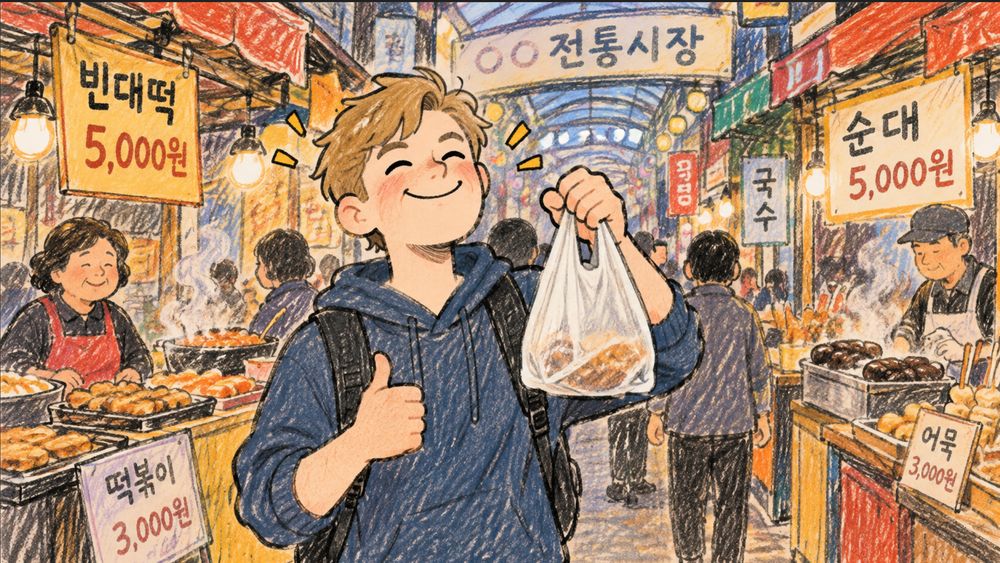
This happened a few years back. Things have gotten a lot better since then, but back then, this was something foreign visitors could run into at traditional markets. Even now, I still think there's room for improvement.
It was Timmy's first trip to Korea. I decided to take him around a traditional market.
The second we walked in, his eyes couldn't keep up. Food smells coming from every direction, narrow alleys lined with stalls on both sides. It looked nothing like the restaurants he'd been to so far, so he kept stopping in front of every stall to look. I walked next to him explaining what things were and how you were supposed to eat them.
At some point I ducked off to find a bathroom. When I came back a few minutes later, Timmy was standing there grinning, holding a wrapped-up snack, waiting for me.
"This looked so good, I bought it."
Then, pretty proudly, he added:
"I bought something by myself for the first time in Korea!"
I laughed. Honestly, it was kind of impressive. At that point Timmy barely spoke any Korean. The only things I'd taught him were basics like "annyeonghaseyo" and a handful of short phrases. And somehow, he'd walked up to a stall by himself, picked something out, ordered it, and gotten it wrapped up to go.
He looked genuinely pleased with himself. Shoulders back, chest out, the whole thing.
I was pretty proud of him too, honestly. But then something occurred to me.
Wait a second. Timmy hadn't exchanged any money. And I definitely hadn't given him cash. So how did he actually pay for this?
"Wait, how did you pay for this?"
He pointed casually at the stall like it was obvious.
"Oh, that? Over there."
That's when it clicked. Obviously, they hadn't been able to communicate much, so he must have somehow gestured that he didn't have any money and that his friend — me — would come pay. No shared language, but apparently a full-body performance had gotten the point across.
I put my hand on my forehead. Ah. So I'm the one paying for this.
We walked back to the stall together. I asked how much it was.
"Excuse me — how much?"
The number the vendor said stopped me for a second.
"Wait, ten thousand won?"
I checked the price tag again. It clearly said 5,000 won.
"Sir, the sign says 5,000 won. Why is it 10,000?"
The vendor started explaining something. I looked at the sign again, then the food, then Timmy. A minute ago he'd been so proud of himself. Now he was watching the two of us go back and forth, clearly picking up that something wasn't right.
We stood there for a while, going back and forth with the vendor. Timmy just stood next to us, looking between our faces. The confidence from a few minutes ago had drained out of him completely.
I told him it was fine. Because honestly, none of this was his fault. He'd just found something that looked good and ordered it the best way he knew how — a mix of the little Korean he had and a lot of gestures. If anything, I felt kind of bad. This was his first time buying anything on his own in Korea, and it had turned into this.
On the way home, I kept thinking about it. What if I hadn't been there? Would he have even noticed the price didn't match the sign? And even if he had, could he have actually done anything about it, barely speaking the language? Probably not.
Things have changed a lot since then
There's been real news coverage about this kind of problem, too. In recent years, the Korean government and local governments have introduced measures to make prices clearer, improve transparency, and crack down on unfair pricing. Seoul, for example, started sending "mystery shoppers" — including foreign nationals — into some of its busiest markets to quietly check whether vendors are marking prices honestly and charging what's actually posted.
To be clear, most vendors aren't doing this. I've been to plenty of traditional markets over the years, and the vast majority are just regular people running a regular business. But if you're a tourist, the experience can look different. You might not know where the prices are posted, what the pricing is even based on, how big a normal portion is, or what you're supposed to double-check before paying. And when something does go wrong, not speaking the language makes it a lot harder to sort out on your own.
That day made me look at traditional markets a little differently. That doesn't mean every market in Korea is unsafe — plenty of improvements have actually happened, with clearer pricing and more foreign-language signage at markets that see a lot of tourists. So I don't want to talk about Korean traditional markets today based only on that one experience years ago. At the same time, I don't think the problem has completely disappeared either.
For a foreign visitor, a Korean traditional market can be a genuinely special place. Unfamiliar food everywhere, unfamiliar smells, narrow alleys packed with people — just walking through it is an experience in itself. I'd rather that experience stick with someone as "there was this place in Korea I never expected" than as "I got scammed in Korea."
Funny enough, what I remember most from that day isn't the awkward part at the end. It's how proud Timmy looked when he came back holding that snack.
He'd barely spoken any Korean, walked into a market he'd never been to before, somehow managed to order something by himself, and came back looking like he'd just accomplished something huge.
And honestly, he had.