Korea Doesn't Have the Most Amazing Sights. So Why Can't People Stop Thinking About It?
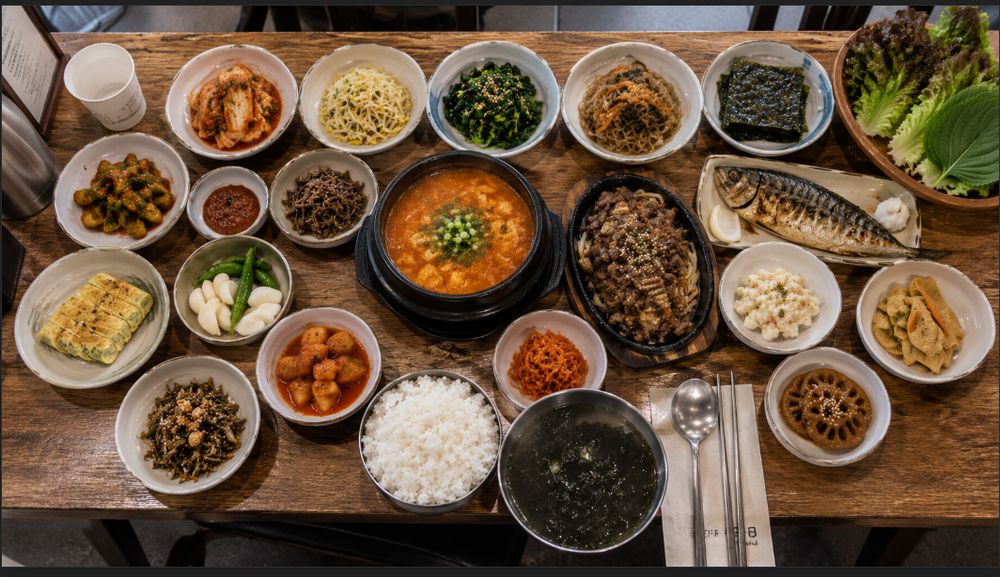
A friend of mine in the US called me the other day.
He visited Korea last year, and we still catch up on calls every once in a while. But ever since that trip, he's developed a weird habit. He brings up Korean restaurants constantly. Bring up food, and he practically starts wailing.
"I want to go back to that Korean place."
"I want those side dishes again."
"Why doesn't the US have that?"
At first I figured he just missed Korean food in general. But thinking about it more, of course Korean restaurants worked on him. This guy eats more than most people, handles spicy food fine, and isn't picky about anything. Taking him to a Korean restaurant was basically heaven.
You order one dish, and the table fills up anyway
This is one of the things that catches first-time visitors off guard at Korean restaurants. You order a single main dish, and then food just starts showing up on the table — one plate at a time.
Kimchi. Some seasoned vegetables. Pickled radish. Maybe a few slices of fish cake, or whatever else the kitchen has that day.
Here's the part that throws people off: none of this was ordered. These are just the side dishes — banchan — that come standard with a main course. My friend was pretty surprised the first time.
"Did you order this too?"
"Nope."
"So... how much does this cost?"
"It's just included."
That's probably around when he started falling for Korean restaurants. But the real kicker comes next: once you finish a side dish, you can ask for more. Finished the kimchi? Ask for more kimchi. Same goes for most of the other banchan. It varies by restaurant, and not every side dish gets refilled — but in Korea, asking for a free refill on banchan isn't considered unusual in the slightest.
If you want to try asking yourself, a simple "banchan deo juseyo" (반찬 더 주세요) — "more banchan, please" — is all it takes.
To Koreans, this is just... normal
Honestly, I've lived here my whole life and never thought twice about any of this. Side dishes show up, you finish them, you ask for more, you eat until you're full, you leave. That's just how it works.
But seeing it through a foreign friend's eyes, it looked different. You order one main dish, several small plates show up, and when you finish them, they just bring more. For him, that was a pretty novel experience — especially for someone who genuinely loves eating as much as he does.
There are limits, of course. Free doesn't mean unlimited. Taking a little, asking for more, leaving some, asking again — that's not really okay, and it puts the restaurant in an awkward spot. The general rule is to ask for roughly what you'll actually eat and not leave leftovers. But within that, there's no need to feel awkward about asking for a bit more banchan.
I think this comes down to jeong
Why does this kind of thing even exist at Korean restaurants? There's no single clean answer. But I think it has something to do with a feeling Koreans call jeong — a word that doesn't really translate cleanly into English, but roughly means a kind of warmth, care, or emotional attachment toward people.
It's the same instinct behind "you came all this way, so eat until you're full." The same reason people bring out extra food when guests show up at their house, or make sure someone eating at their table never feels like they didn't get enough.
To Koreans, it's so ordinary that it barely registers. But to someone from a different food culture, it can leave a real impression. That's probably exactly what happened to my friend. He was surprised at first, and at some point, he just fell for it — the banchan specifically. And now he calls from the US every so often and says it.
"I really want to go back to that Korean restaurant."
Then he starts talking about the side dishes again. It gets me every time — the kimchi, the seasoned vegetables, the fish cake I used to eat without a second thought back home have somehow become the thing my friend, halfway across the world, can't stop craving.
And my friend still hasn't gotten over it. Every time he calls, he says pretty much the same thing.
"I want to go back to that Korean place."